


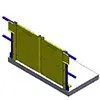


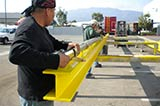


Non-penetrating guardrails help eliminate the need to drill into the roof structure, reducing the risk of leaks, preserving roof warranties, and simplifying installation.
FAQs
Aluminum access stairs are lightweight, corrosion-resistant, durable, and easy to install. They are well suited for both indoor and outdoor applications where long-term performance and low maintenance are important.
FAQs
Cal-OSHA fall protection guardrails are subject to strict requirements, primarily outlined in the California Code of Regulations. Key standards include a top rail height of 42–45 inches above the walking surface, a requirement for a midrail or equivalent, and a minimum strength of 20 pounds per linear foot for a live load. Posts must be spaced no more than 8 feet apart on center.
- Title 8, Section 3209: Standard Guardrails. More strict than the federal rules for guardrails and roof fall protection systems.
- Title 8, Section 1620: Design and Construction of Railings. More strict than the federal rules for guardrails and roof fall protection systems.
Visit: CAI Safety Systems Guardrail Fall Prevention Systems
FAQs
For personal fall arrest / personal fall protection anchorages, OSHA generally requires anchor points to be either:
- Rated to 5,000 lb per worker attached, or
- Engineered as part of a complete system with a safety factor of at least 2, under the supervision of a qualified person. OSHA.gov
Related CAISS resources:
FAQs
- 29 CFR 1910.29: General industry standard for fall protection systems and falling object protection.
- 29 CFR 1926.502: Criteria and practices for fall protection systems in construction.
- 29 CFR 1926.501: Duty to have fall protection, including when working at the edges of excavations or over dangerous equipment.
FAQs
ANSI standards require energy absorbers to limit maximum arrest force to specified levels during dynamic testing to help reduce impact forces on workers.
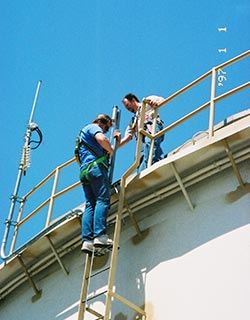
CAI offers roof fall protection options including non-penetrating guardrails, fixed roof anchors, roof horizontal lifeline systems, roof hatch guards, and skylight protection. Fixed ladder fall protection options include cable and rigid-track ladder safety systems. Selection depends on the roof or ladder configuration, access points, supporting structure, and how employees move through the work area.
CAI offers authorized person, competent person, and train-the-trainer fall protection training. The appropriate course depends on whether participants use the equipment, oversee work at height, or train other employees. Tell us which fall protection systems your team uses and each participant’s responsibilities so we can recommend training suited to your workplace.
Guardrail systems are widely used in manufacturing facilities, warehouses, commercial buildings, schools, hospitals, utility plants, distribution centres, and industrial facilities with rooftop access requirements.