


FAQs

FAQs

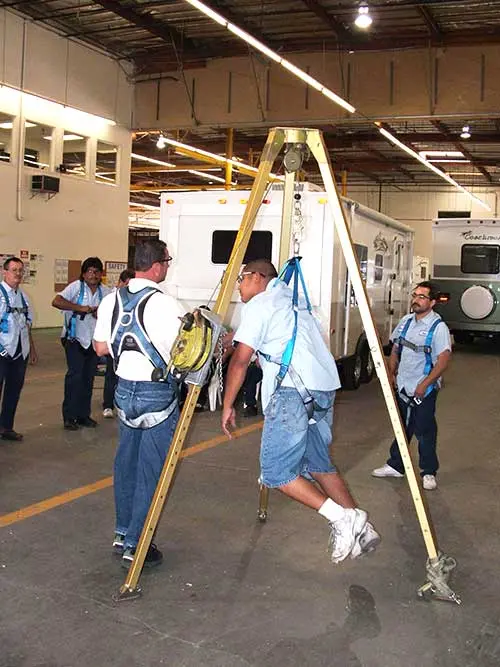
Fall protection training is a safety program that teaches workers how to recognize fall hazards, properly use fall protection equipment, and follow OSHA and ANSI requirements when working at height.

FAQs

A safety assessment may include hazard identification, site inspections, policy reviews, risk evaluations, and recommendations for corrective actions.

OSHA fall protection refers to the regulations, requirements, and safety practices established by the Occupational Safety and Health Administration (OSHA) to protect workers from fall hazards in the workplace.
Roof fall protection refers to systems, equipment, and safety solutions designed to help protect workers from falls while performing tasks on rooftops, elevated structures, and building surfaces.

FAQs

Non-penetrating systems help eliminate the need to drill into the roof structure, reducing the risk of roof leaks, preserving warranties, and simplifying installation.

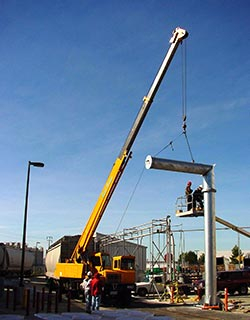
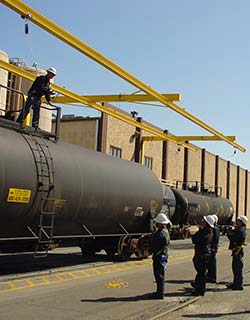
An overhead anchorage helps minimize free-fall distance, reduces swing-fall hazards, improves worker mobility, and provides continuous fall protection throughout the work area.
A cable fall arrest system uses a vertical cable lifeline and traveler, while a rigid track system uses a fixed rail and trolley that automatically follows the worker during ascent and descent for hands-free climbing.
A Class 1 SRL is generally intended for applications where the anchorage is at or above the worker's dorsal D-ring and the lifeline is not exposed to a leading edge. A Class 2 SRL is designed and tested for more demanding anchorage configurations, including certain leading-edge applications and anchorage at or below the dorsal D-ring when permitted by the manufacturer. Class 2 is not automatically better; the correct class depends on anchor height, edge exposure, fall clearance, and the specific application.

FAQs

Competent person: Someone capable of identifying hazards and authorized to take prompt corrective measures.
Qualified person: Someone with a recognized degree/certificate/professional standing, or extensive knowledge/training/experience, who has demonstrated ability to solve problems related to the work or project (commonly the person who designs/engineers systems).

Related CAISS resources:

FAQs

A fixed anchor is permanently attached to a structure and remains in place for ongoing use, while a portable anchor can be moved between locations to provide temporary fall protection as needed.

A horizontal opening mezzanine gate moves horizontally and is ideal where overhead clearance is limited, while a vertical opening gate operates upward and may be better suited for facilities with sufficient vertical space.
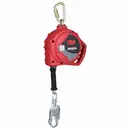
A self-retracting device, or SRD, is the broad term for equipment that automatically extends, retracts, and locks during a fall. A self-retracting lifeline, or SRL, is a common type of SRD. A personal fall limiter, or PFL, is generally a compact SRD designed for shorter working distances and direct attachment to a full-body harness. Confirm the approved use from the product label and manufacturer instructions.
Fall prevention systems help stop workers from reaching a fall hazard, while fall arrest systems are designed to safely stop a worker after a fall has occurred.

FAQs


FALL ARREST

FALL RESTRAINT

Fall Arrest is reactive — it allows a worker to move freely near or over a fall hazard, but catches them after a fall begins. The system arrests the fall before the worker hits a lower level. Fall Restraint is restrictive — it stops a worker from ever reaching a fall hazard. The lanyard or tether is short enough that the worker physically cannot get to the edge. No fall occurs.
  • The worker can move freely, including over or near the fall hazard
  • The system activates after a fall begins, catching the worker mid-fall
  • OSHA requires free fall be limited to 6 feet, with total fall arrest (including deceleration) within about 9.5 feet
  • Requires a full harness, deceleration device, and verified clearance to a lower level
  • More common on structures, towers, ladders, and elevated platforms
  • The tether/lanyard is short enough that the worker physically cannot reach the hazard edge
  • No fall ever happens — it is entirely restrictive
  • Because no fall occurs, there's no arrest force on the body
  • Simpler to implement in some cases, but limits worker mobility
  • Typically used on flat roofs and leading-edge work where the hazard is predictable
Fall Arrest versus Fall Restraint

FAQs

NSI standards specify that a personal fall arrest system should limit the maximum arrest force to 1,800 pounds (8.0 kN) when tested according to the applicable requirements.

FAQs

OSHA updated its Walking-Working Surfaces rules (general industry, 29 CFR 1910 Subpart D & related fall protection rules) with a final rule published in November 2016 and effective January 2017, aimed at reducing slip/trip/fall hazards.

FAQs

Train the Trainer courses are designed for individuals who will be responsible for delivering fall protection training within their organization and educating Authorized Persons.

Crossover stair bridges are commonly manufactured from aluminum, galvanized steel, stainless steel, or other durable materials selected based on the application and environmental conditions.
Fixed roof anchors are commonly manufactured from galvanized steel, stainless steel, aluminum, or other corrosion-resistant materials suitable for rooftop environments.
Fold down ladders are commonly manufactured from aluminum, galvanized steel, stainless steel, or other durable materials selected based on environmental conditions and application requirements.