







FAQs
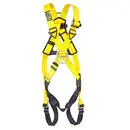
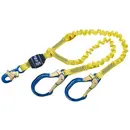
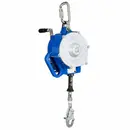
User equipment comprises devices such as SRLs, Harnesses, Lanyards, etc. You are required by law, and the manufacturer of the equipment, to adhere to strict inspection, use, and maintenance requirements. At CAISS, our competent inspectors conduct comprehensive functional tests on the fall protection equipment to ensure that it is operating properly and that all components are working together as intended.
NOTE: CAISS does not repair your equipment in this inspection program. We will provide you with suggestions on the necessary repair, replacement, or modification of the equipment on inspection completion in a detailed report.
- Placing your order online: Visit Fall Protection User Equipment Inspection page and place your order by choosing the correct equipment. Input the "Brand" and "Model #" of the equipment. (if you do not have this on hand, CAISS will contact you after receiving the order)
- Once the above information is received, our customer service will provide you with a Inspection Authorization Number (IAN#). Reference this number on the exterior of all packages you are shipping.
- When shipping your equipment to CAISS, please remember to arrange a return as well with your shipping carrier.
- Inspection paperwork is included with all repaired products returned to you.
- Upon completion of the service, we will confirm shipment to the destination noted on the purchase order.
- The program guarantees a 4-5 business days turnaround time up to 12 units. For more than 12 units, please call us to verify lead time.
- The client is responsible for freight costs to CAISS and return to the client.
Related CAISS resources:
FAQs
ANSI standards emphasize proper training, and OSHA requires workers exposed to fall hazards to be trained by a competent person to recognize hazards and use fall protection equipment correctly.
FAQs
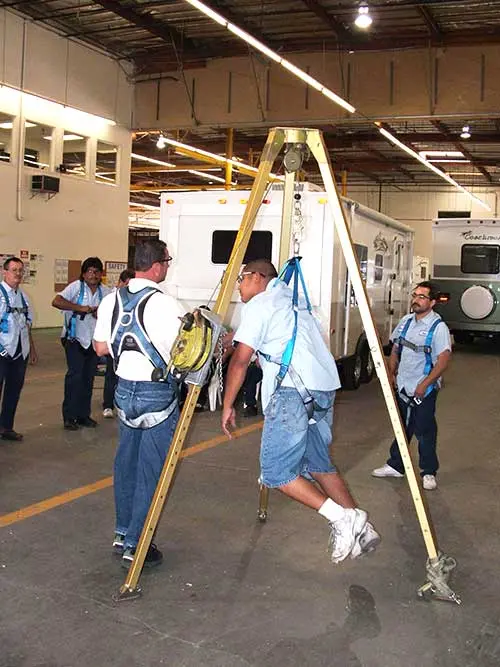
Yes. Training combines classroom instruction with practical hands-on exercises, equipment demonstrations, inspections, and real-world fall protection scenarios.
FAQs
The lead time for material depends on various factors such as availability, packaging, transit time, holiday schedules, and market transport delays.
Lead times for all material is mentioned in the quotation/proposal we send you.
To find out lead times on online orders, simply send us an email by replying to your order confirmation, and we will respond to you.
Otherwise, you can call or email us about the lead times for all systems, and we will let you know the estimated delivery window.
FAQs
CAISS provides the following payment terms to first time clients.
- 50% upon order and 50% NET10 upon delivery
- There is a 5% PO processing fee added to the order.
- We will need a credit card on file and will verify availability of funds to cover the final 50% before processing the order.
- Card will not be charged if final payment is received in a timely manner when invoiced 10 days after delivery of order.
- CAISS does not collect Sales Tax on these orders, except for the state of California.
- Credit references are not required, however, in some instances we may request this.
In summary, we invoice the first 50% of the order when order is placed. Once the order has been delivered, CAISS will invoice the remaining 50% 10 days after delivery.
Returning clients automatically qualify for 100% NET30 payment terms, provided an order is placed at least 2 years (24 months) from their last order with us. CAISS will analyze this on a case-by-case basis.
CAISS does not provide NET30, NET60, NET90, or any other payment terms to first time clients.
FAQs
All quotations and orders include the following Processing Fees:
- Credit Card Processing Fee: 2.9%
- This fee is associated with the credit card company that CAISS is in partnership with.
- ACH/Bank Transfer Processing Fee: $0.00
- When you select the 'ACH/Bank Transfer' payment option at checkout, there is no processing fee included with a Bank to Bank transfer / wire transfer.
- If your bank requires an additional transfer fee, please do not include this fee as part of the order total amount.
- Check Payment Processing Fee: $0.00
- When you select the 'Check Payment' payment option at checkout, there is no processing fee included. Simply mail us your check payment.
- PO Processing Fee: 5%
- This fee is associated with manual order processing by CAISS staff for orders on Payment Terms such as NET10, NET30, etc.
FAQs
Prices listed on this Website are valid for and at the time of order placement on the Website. All prices are subject to change without notice.
Every quotation issued by CAISS has an expiration date. The pricing quoted on the proposal expires on that expiration date and is subject to change.
FAQs
All quotations issued by CAISS are valid for 30 days from the date the quotation was sent to the client (via email).
After 30 days of receiving the quotation, pricing on items may be subject to change without prior approval, and may require to be requoted.
The validity of the quotation has been mentioned in the quotation email and PDF provided to the client.
- Quotation created on: XXX Date
- Quotation valid until: XXX Date
FAQs
Both Authorization and a Return Number must be issued by the factory on all returns.
Credit will not be issued for custom built items. Only unused stock items with a purchase date of two (2) months or less will be considered for return.
CAISS accesses returns on a case-by-case basis. Authorized returns will only be accepted for credit toward future purchases from CAISS, less a minimum 15% restocking charge or other handling charges, or costs.
For returns, ensure return number is visibly marked on the exterior of all packages. Customer will be advised by CAISS for returns.
FAQs
CAISS has an affiliation with TaxCloud which is the leading tax reporting agency for tax compliance across the US. TaxCloud® is a Registered Trademark of The Federal Tax Authority, LLC. Our online website is integrated with TaxCloud and automatically calculates Sales Tax during the checkout process.
CAISS COLLECTS SALES TAX in states where we have physical presence (or nexus). The following are the US States CAISS does not mostly collect Sales Tax from: AL, AR, CO, FL, HI, ID, IA, MD, MO, NM, PA, NY. If Sales Tax is included in these states, it is because the taxing authority of that state requires CAISS to collect and report sales tax.
Online orders automatically calculate Sales Tax during the checkout process based on the shipping address/destination entered. If the Sales Tax item is $0.00 at checkout, this means that your State's tax jurisdiction does not allow CAISS to collect Sales Tax. In this case, your company/you may report the purchase to that state's tax jurisdiction.
Payment Term Orders with an issued Purchase Order (PO) do not qualify CAISS to collect Sales Tax, with the exception of California (CA).
FOR CANADA & MEXICO CUSTOMERS ONLY: CAISS does not collect Sales Tax in these countries. However, there are excise duties, taxes, port handling fees, and other customs charges that are involved. As the recipient of this order, these fees and charges, which will not be included as part of your order, are the “SOLE” responsibility of the client or freight broker making the purchase.
Sometimes, CAISS will include excise duties, taxes, port handling fees, and other customs charges in the freight quote to you, and will specifically mention it.
FAQs
Online orders automatically calculate Sales Tax during the checkout process based on the shipping address/destination entered.
If you are Sales Tax Exempt, you can go ahead and place your order with Sales Tax included. Once we receive your order email, let us know that you are Tax Exempt and provide us with a copy of your Sales Tax Exemption/Resale Certificate. CAISS will then VOID the Sales Tax on the order before processing payment. This certificate is absolutely necessary for CAISS to process your order with an exemption.
If a customer is not able to provide a copy of their Tax-Exempt Certificate to CAISS (digitally via email) after the order has been placed, CAISS will charge the customer the required Sales Tax to process and complete their order.
FAQs
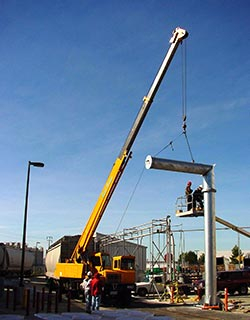
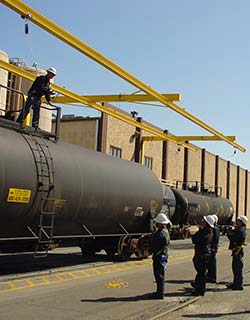
Fall protection anchors are commonly used on rooftops, tanks, railcars, tanker trucks, buses, earth-moving equipment, industrial facilities, and other elevated work areas where fall hazards exist.
FAQs
Access stairs and platforms provide safe access to elevated work areas, rooftops, equipment, machinery, and maintenance locations. They help workers reach difficult areas while reducing fall hazards and improving workplace safety.
FAQs
Fold-down ladders provide convenient access to roof spaces, ceiling cavities, and maintenance areas from inside a building. They can be folded away when not in use to maximize available space.
Self-retracting lifelines are fall protection devices that automatically extend and retract while locking during a fall to arrest worker movement and reduce fall distance.