

Fall Protection FAQs – Frequently Asked Questions

Common frequently asked questions regarding fall protection, OSHA, ANSI, and Cal-OSHA Compliance, and various other safety topics

Fall protection is a safety regulatory system designed to prevent falls, required at different heights depending on the industry (e.g., 4 feet in general industry, 6 feet in construction). A complete system includes railing, anchor points, body harnesses, and lanyards, and requires regular inspection by a “competent person” before each use and annually. OSHA also requires employers to have a documented fall protection plan, which should include rescue procedures in case of a fall. Always refer to the manufacturer’s “Installation, Operation, and Maintenance” (O&M) documentation before installing any OSHA compliant fall protection system.

Safety note: Requirements can vary by industry, task, and jurisdiction. When in doubt, have a competent person evaluate the work area and select the right protection method or contact CAISS.


What industries commonly use guardrail fall prevention systems?

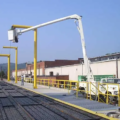
Guardrail systems are widely used in manufacturing facilities, warehouses, commercial buildings, schools, hospitals, utility plants, distribution centres, and industrial facilities with rooftop access requirements.

How do I choose the right guardrail system for my facility?

The best guardrail solution depends on factors such as roof type, building layout, fall hazards, worker access requirements, and applicable OSHA regulations. CAI Safety can help determine the most appropriate system for your specific application.

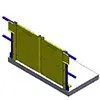
An industrial safety gate is a self-closing barrier designed to protect workers from fall hazards at ladder openings, roof hatches, mezzanines, loading areas, and other elevated access points.
Industrial safety gates are commonly installed at ladder access points, roof hatches, mezzanine edges, loading docks, platforms, walkways, and other areas where workers are exposed to fall hazards.
Safety gates help create a controlled access point by automatically closing after passage, reducing the risk of accidental falls and helping maintain a continuous protective barrier.
Yes. Properly designed and installed industrial safety gates can help facilities comply with OSHA requirements for fall protection and safe access to elevated work areas.
Yes. CAI Safety offers self-closing industrial safety gates designed to automatically return to the closed position after use, helping maintain continuous fall protection.
Yes. Safety gates can typically be retrofitted onto existing ladders, platforms, mezzanines, roof access points, and industrial structures to improve worker safety.
Industrial safety gates are commonly manufactured from durable materials such as galvanized steel, powder-coated steel, or aluminum to withstand harsh industrial environments and outdoor exposure.
Industrial safety gates are widely used in manufacturing facilities, warehouses, distribution centers, utility plants, commercial buildings, transportation facilities, and industrial processing plants.
Yes. Industrial safety gates are frequently used in conjunction with roof hatches and ladder access systems to help protect workers when entering or exiting rooftop areas.
The appropriate safety gate depends on the opening size, access point type, environmental conditions, fall hazards, and applicable safety requirements. CAI Safety can help identify the most suitable solution for your application.
A loading dock safety gate is a fall protection barrier designed to secure open loading dock edges and truck bays, helping prevent workers, pedestrians, and equipment from accidentally falling from elevated dock areas. CAI Safety offers cantilever gate systems specifically designed for loading dock applications.
Loading docks are common workplace fall hazards. Safety gates help create a protective barrier when trucks are not present, reducing the risk of falls and improving overall workplace safety.
CAI Safety offers Single Opening Cantilever Gates and Split Opening Cantilever Gates designed to protect loading dock openings while maintaining operational efficiency.
A single opening cantilever gate is designed for smaller loading dock openings and overhead door applications. It opens upward rather than swinging outward, helping preserve valuable floor space while providing fall protection.
A split opening cantilever gate is designed for wider dock openings and larger truck bays. The system provides fall protection while allowing easy access for loading and unloading operations.
Yes. CAI Safety states that its loading dock cantilever gate systems meet or exceed OSHA fall protection requirements for loading dock applications.
CAI Safety loading dock gate systems are available for a variety of opening widths. Single opening gates can accommodate openings from approximately 4 to 12 feet, while split opening gates can protect larger openings.
Unlike traditional swing gates, cantilever gates open vertically upward, eliminating the need for side clearance and preserving valuable workspace around the loading dock area.
Yes. Loading dock safety gates are commonly used in warehouses, manufacturing facilities, distribution centers, logistics operations, and industrial buildings where trucks regularly load and unload materials.
The appropriate solution depends on factors such as dock opening width, available overhead clearance, traffic patterns, loading operations, and OSHA compliance requirements. CAI Safety can help determine the most suitable gate system for your specific application.
A ladder opening safety gate is a self-closing barrier designed to protect workers from falls at ladder access points, elevated platforms, mezzanines, and rooftop access locations by securing open entryways.
Ladder openings create fall hazards whenever workers enter or exit elevated areas. Safety gates help maintain continuous fall protection and reduce the risk of accidental falls.
Safety gates are commonly installed at fixed ladder openings, rooftop access points, mezzanines, platforms, catwalks, maintenance areas, and elevated workspaces.
Self-closing gates automatically return to the closed position after a worker passes through, helping ensure that the opening remains protected without requiring manual closure.
Yes. Properly designed and installed ladder opening safety gates can help facilities comply with OSHA requirements for protecting ladderway floor openings and elevated access points.
Yes. Most ladder opening safety gates can be retrofitted onto existing ladders, guardrail systems, platforms, and access structures to improve workplace safety.
Ladder safety gates are typically manufactured from durable materials such as galvanized steel, powder-coated steel, stainless steel, or aluminum for long-term performance in industrial environments.
These safety gates are widely used in manufacturing facilities, warehouses, utility plants, commercial buildings, water treatment facilities, energy operations, and industrial processing plants.
Yes. Many ladder opening safety gates are designed for both indoor and outdoor applications and can withstand exposure to weather, moisture, and harsh environmental conditions.
The appropriate safety gate depends on factors such as opening width, mounting location, environmental conditions, worker access requirements, and applicable OSHA safety standards. CAI Safety can help identify the best solution for a specific application.
A ladder fall arrest system is a safety system designed to protect workers while climbing fixed vertical ladders by arresting a fall and reducing the risk of serious injury. These systems commonly use a cable lifeline or rigid rail track connected to a worker's harness.
Ladder fall arrest systems are commonly installed on fixed ladders attached to water tanks, towers, utility poles, rooftops, mezzanines, roof hatches, and industrial structures where workers must climb to elevated locations.
CAI Safety offers ladder cable fall arrest systems, ladder rigid track fall arrest systems, roof hatch ladder fall arrest systems, fixed ladder SRL anchors, and systems designed for utility poles and towers.
A cable fall arrest system uses a vertical cable lifeline and traveler, while a rigid track system uses a fixed rail and trolley that automatically follows the worker during ascent and descent for hands-free climbing.
Yes. Properly designed and installed ladder fall arrest systems can help facilities meet OSHA and ANSI requirements for ladder safety and fall protection.
Under OSHA requirements, fixed ladders extending more than 24 feet above a lower level generally require a ladder safety system or personal fall arrest system.
Yes. Many ladder fall arrest systems can be retrofitted to existing fixed ladders, allowing facilities to improve worker safety without replacing the ladder structure.
Yes. CAI Safety offers ladder fall arrest systems specifically designed for roof hatch applications, helping workers remain protected while transitioning through rooftop access points.
Yes. Many ladder fall arrest systems are designed with rescue capability features to assist employers in implementing fall rescue procedures and emergency response plans.
The best solution depends on ladder height, structure type, worker access requirements, environmental conditions, rescue needs, and applicable OSHA or ANSI requirements. CAI Safety can help determine the most appropriate system for a specific application.
A mezzanine safety gate is a fall protection system designed to secure openings in mezzanine platforms, loading areas, and elevated workspaces, helping protect workers from falls during material handling and access activities.
Mezzanine openings create significant fall hazards when materials are loaded or unloaded. Safety gates provide a protective barrier that helps prevent accidental falls while maintaining safe access to elevated work areas.
CAI Safety offers horizontal opening gates, vertical opening gates, pallet self-closing gates, pallet rack gates, mini dual mezzanine gates, mega dual mezzanine gates, and other custom mezzanine gate solutions.
A horizontal opening mezzanine gate moves horizontally and is ideal where overhead clearance is limited, while a vertical opening gate operates upward and may be better suited for facilities with sufficient vertical space.
A pallet self-closing gate is designed to protect mezzanine loading zones by automatically maintaining a protective barrier during pallet transfer operations, helping reduce fall risks.
Yes. CAI Safety states that its mezzanine safety gate systems are designed to comply with applicable OSHA and ANSI fall protection requirements.
Yes. Many mezzanine gate systems are available in custom sizes and configurations to accommodate specific platform dimensions, material handling requirements, and facility layouts.
Yes. Certain CAI Safety mezzanine gate systems can be supplied with automated or electrically operated functionality to improve operational efficiency and worker safety.
Mezzanine safety gates are widely used in warehouses, manufacturing facilities, distribution centers, logistics operations, industrial plants, and commercial facilities where elevated storage or work platforms are present.
The appropriate gate depends on factors such as opening size, available clearance, material handling methods, pallet transfer requirements, worker access needs, and applicable safety regulations. CAI Safety can help determine the most suitable solution for a specific application.
A mobile fall protection system is a portable safety solution designed to provide fall protection for workers performing tasks at height without requiring permanent installation. These systems can be moved between work areas as needed.
Mobile fall protection systems are commonly used for maintenance, inspections, construction activities, aircraft servicing, vehicle maintenance, rooftop work, and industrial operations where permanent fall protection is not practical.
CAI Safety offers a variety of mobile fall protection solutions, including mobile anchor systems, portable guardrail systems, mobile horizontal lifeline systems, and mobile access platforms for different work environments.
Mobile systems provide flexibility, portability, rapid deployment, and fall protection in multiple locations without requiring permanent modifications to the facility or structure.
Yes. Properly selected and used mobile fall protection systems can help employers comply with applicable OSHA fall protection requirements and workplace safety regulations.
Yes. Many mobile fall protection systems are designed for both indoor and outdoor use and can be deployed in warehouses, manufacturing facilities, transportation yards, utility sites, and commercial buildings.
Many mobile fall protection systems are non-penetrating and do not require attachment to the building structure, helping preserve roof integrity and facility assets.
Yes. Mobile fall protection systems are commonly used with compatible personal fall arrest equipment such as full-body harnesses, lanyards, self-retracting lifelines (SRLs), and connectors.
Mobile fall protection systems are widely used in manufacturing, aviation, transportation, utilities, warehousing, construction, energy, and facility maintenance industries.
The appropriate system depends on worker mobility requirements, work area size, fall hazards, environmental conditions, required anchorage capacity, and applicable OSHA or ANSI requirements. CAI Safety can help identify the best solution for a specific application.
OSHA fall protection refers to the regulations, requirements, and safety practices established by the Occupational Safety and Health Administration (OSHA) to protect workers from fall hazards in the workplace.
OSHA generally requires fall protection when workers are exposed to falls of 4 feet or more in general industry, 5 feet in maritime operations, 6 feet in construction, and 8 feet in longshoring operations.
OSHA recognizes several forms of fall protection, including guardrail systems, personal fall arrest systems (PFAS), safety nets, warning line systems, travel restraint systems, and designated area systems where applicable.
A personal fall arrest system is a combination of equipment including an anchorage, full-body harness, and connecting device designed to safely stop a worker during a fall.
Yes. OSHA requires employers to train workers who may be exposed to fall hazards so they can recognize risks and properly use fall protection equipment and procedures.
Fall prevention systems help stop workers from reaching a fall hazard, while fall arrest systems are designed to safely stop a worker after a fall has occurred.
Yes. OSHA requires fall protection equipment to be inspected regularly to ensure it remains in safe working condition and capable of performing as intended.
Fall protection is commonly required in construction, manufacturing, warehousing, utilities, transportation, telecommunications, facility maintenance, and industrial operations where employees work at elevated locations.
Employers can improve compliance by conducting hazard assessments, implementing fall protection plans, providing worker training, performing equipment inspections, and using OSHA-compliant fall protection systems.
Yes. CAI Safety offers OSHA-compliant fall protection systems, safety equipment, training programs, engineered solutions, and consulting services designed to help organizations improve worker safety and regulatory compliance.
A self-retracting lifeline, commonly called an SRL, is a fall-arrest device with a lifeline that extends and retracts as the worker moves. During normal movement, the line remains under light tension. If a fall occurs, an internal braking mechanism locks the lifeline and helps arrest the fall. The SRL must be compatible with the worker's full-body harness, anchorage, work environment, and required fall clearance.
A self-retracting device, or SRD, is the broad term for equipment that automatically extends, retracts, and locks during a fall. A self-retracting lifeline, or SRL, is a common type of SRD. A personal fall limiter, or PFL, is generally a compact SRD designed for shorter working distances and direct attachment to a full-body harness. Confirm the approved use from the product label and manufacturer instructions.
A Class 1 SRL is generally intended for applications where the anchorage is at or above the worker's dorsal D-ring and the lifeline is not exposed to a leading edge. A Class 2 SRL is designed and tested for more demanding anchorage configurations, including certain leading-edge applications and anchorage at or below the dorsal D-ring when permitted by the manufacturer. Class 2 is not automatically better; the correct class depends on anchor height, edge exposure, fall clearance, and the specific application.
A leading-edge or Class 2 SRL should be considered when the lifeline may contact or travel over an exposed edge during a fall, or when the anchorage must be located below the worker's dorsal D-ring. The SRL must be specifically tested and approved for the anticipated condition. Review the manufacturer's instructions for permitted anchor height, setback distance, edge requirements, swing-fall limits, and required fall clearance.
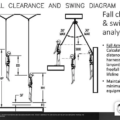
Required fall clearance varies by SRL model, anchorage height, worker location, free-fall distance, deceleration distance, worker height, harness stretch, and the safety margin above the lower level. Do not rely on one universal clearance value. Use the manufacturer's fall-clearance chart and evaluate the actual work area before selecting the device. A qualified fall protection competent person should confirm that adequate clearance is available.
Swing fall occurs when a worker moves horizontally away from the anchorage and falls in a pendulum-like path. The worker may strike a wall, column, equipment, or another obstruction. Locate the anchorage as directly overhead as practical, limit side travel, and follow the manufacturer's allowable working-angle and setback requirements. A horizontal lifeline or mobile anchorage may be needed when the work area is too wide for one fixed anchor.
A single-leg SRL is appropriate when the worker can remain connected to one compatible anchorage throughout the task. A dual-leg SRL can help maintain continuous fall protection while the worker transitions between approved anchor points. The unused leg must be handled and parked according to the manufacturer's instructions. Device weight, connector type, anchorage compatibility, worker movement, and fall clearance should be considered before selection.
Web lifelines are lightweight and commonly used for compact SRLs and harness-mounted PFLs. Wire-rope or steel-cable lifelines can provide increased abrasion resistance and may be offered in longer lengths or sealed units for demanding environments. However, metal lifelines may not be appropriate near electrical hazards. Consider sharp edges, welding, heat, moisture, chemicals, corrosion, electrical exposure, weight, and required length when choosing the lifeline material.
Arc-flash and welding work require an SRL specifically approved for the expected electrical, heat, spark, and molten-metal exposure. Standard webbing or cable should not be assumed suitable for these hazards. Select equipment with the appropriate manufacturer rating and protective materials, and keep the lifeline away from sharp edges, hot surfaces, welding spatter, and energized components. Evaluate the complete fall-protection system for the specific task.
An order-picker SRL should be approved for use with the equipment, platform, harness, and designated anchorage. Evaluate the available anchor height, platform location, worker movement, SRL length, and fall clearance. The anchorage arrangement must follow the order-picker manufacturer's requirements, the SRL manufacturer's instructions, and the employer's fall protection program.
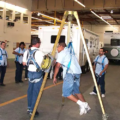
Only an SRL specifically designed with an approved rescue or retrieval function should be used for confined-space recovery. A retrieval SRL may allow an attendant to raise or lower a worker after a fall or emergency. It must be used with a compatible tripod or davit, anchorage, retrieval system, harness, and site-specific rescue plan. A standard fall-arrest SRL without a retrieval function should not be treated as a rescue device.
Inspect the SRL before each use or work shift for damaged webbing or cable, cuts, abrasion, corrosion, distorted connectors, unreadable labels, improper retraction, and failure of the locking mechanism. Complete formal periodic inspections at the frequency required by the manufacturer and the employer's fall protection program. Any SRL that arrests a fall must be removed from service immediately and evaluated before reuse.
CAI Safety can help evaluate the application type, anchor location, Class 1 or Class 2 capability, leading-edge exposure, required length, fall clearance, swing-fall potential, lifeline material, connector configuration, rescue requirements, and work environment. Use the filters on this page to narrow the available products, then contact CAI Safety for additional selection assistance. Final equipment selection and system compatibility must be confirmed by a qualified fall protection competent person.
An overhead fall protection system is an elevated anchorage solution that allows workers to connect personal fall arrest equipment to a secure overhead structure, helping reduce fall risks while working at height.
Overhead fall protection systems are commonly used in manufacturing facilities, warehouses, aircraft maintenance hangars, loading areas, transportation facilities, industrial plants, and maintenance operations.
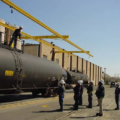
CAI Safety offers overhead rigid rail systems, overhead track systems, bridge systems, workstation fall protection systems, and custom-engineered overhead anchorage solutions.
An overhead anchorage helps minimize free-fall distance, reduces swing-fall hazards, improves worker mobility, and provides continuous fall protection throughout the work area.
Yes. Properly designed, installed, and maintained overhead fall protection systems can help employers comply with OSHA and ANSI fall protection requirements.
Many overhead fall protection systems can be engineered to accommodate multiple users simultaneously, depending on the system design and load capacity requirements.
A rigid rail system uses a fixed overhead rail and trolley assembly that allows workers to move freely while remaining continuously connected to a fall protection anchorage point.
Yes. Overhead fall protection systems can be customized based on facility layout, work processes, available structure, span requirements, worker mobility needs, and applicable safety regulations.
Overhead fall protection systems are widely used in manufacturing, aviation, transportation, energy, utilities, warehousing, military facilities, and industrial maintenance operations.
The appropriate solution depends on the work environment, available overhead structure, worker movement requirements, number of users, fall clearance, and OSHA or ANSI compliance requirements. CAI Safety can help identify the best solution for a specific application.
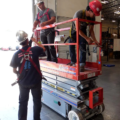
A portable safety ladder is a movable access solution designed to provide safe access to elevated work areas, equipment, platforms, vehicles, and maintenance locations. These ladders can be relocated as needed and often include safety features such as handrails, guardrails, and slip-resistant steps.
CAI Safety offers a variety of portable safety ladders, including rolling platform ladders, mobile access ladders, maintenance ladders, crossover ladders, work platforms, and custom-engineered access solutions for industrial applications.
Portable safety ladders are commonly used in manufacturing facilities, warehouses, distribution centers, transportation operations, aircraft maintenance, utility facilities, and industrial plants where temporary elevated access is required.
Portable safety ladders often provide larger standing platforms, handrails, guardrails, improved stability, and easier access to elevated work areas, helping reduce fall risks and improve worker safety.
Yes. Properly designed and maintained portable safety ladders can help organizations comply with applicable OSHA requirements for safe access and fall protection in the workplace.