




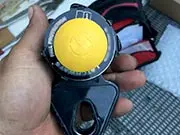
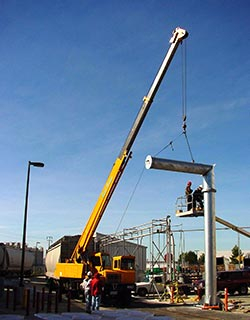

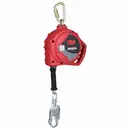
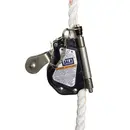
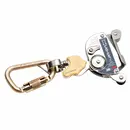

A self-retracting lifeline, commonly called an SRL, is a fall-arrest device with a lifeline that extends and retracts as the worker moves. During normal movement, the line remains under light tension. If a fall occurs, an internal braking mechanism locks the lifeline and helps arrest the fall. The SRL must be compatible with the worker's full-body harness, anchorage, work environment, and required fall clearance.
A self-retracting device, or SRD, is the broad term for equipment that automatically extends, retracts, and locks during a fall. A self-retracting lifeline, or SRL, is a common type of SRD. A personal fall limiter, or PFL, is generally a compact SRD designed for shorter working distances and direct attachment to a full-body harness. Confirm the approved use from the product label and manufacturer instructions.
A Class 1 SRL is generally intended for applications where the anchorage is at or above the worker's dorsal D-ring and the lifeline is not exposed to a leading edge. A Class 2 SRL is designed and tested for more demanding anchorage configurations, including certain leading-edge applications and anchorage at or below the dorsal D-ring when permitted by the manufacturer. Class 2 is not automatically better; the correct class depends on anchor height, edge exposure, fall clearance, and the specific application.
A leading-edge or Class 2 SRL should be considered when the lifeline may contact or travel over an exposed edge during a fall, or when the anchorage must be located below the worker's dorsal D-ring. The SRL must be specifically tested and approved for the anticipated condition. Review the manufacturer's instructions for permitted anchor height, setback distance, edge requirements, swing-fall limits, and required fall clearance.
Required fall clearance varies by SRL model, anchorage height, worker location, free-fall distance, deceleration distance, worker height, harness stretch, and the safety margin above the lower level. Do not rely on one universal clearance value. Use the manufacturer's fall-clearance chart and evaluate the actual work area before selecting the device. A qualified fall protection competent person should confirm that adequate clearance is available.
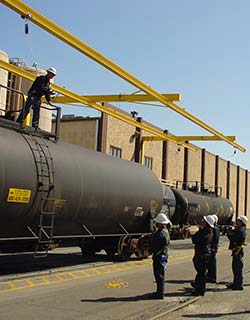
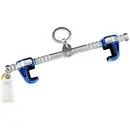
Swing fall occurs when a worker moves horizontally away from the anchorage and falls in a pendulum-like path. The worker may strike a wall, column, equipment, or another obstruction. Locate the anchorage as directly overhead as practical, limit side travel, and follow the manufacturer's allowable working-angle and setback requirements. A horizontal lifeline or mobile anchorage may be needed when the work area is too wide for one fixed anchor.
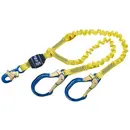
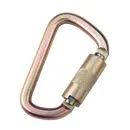
A single-leg SRL is appropriate when the worker can remain connected to one compatible anchorage throughout the task. A dual-leg SRL can help maintain continuous fall protection while the worker transitions between approved anchor points. The unused leg must be handled and parked according to the manufacturer's instructions. Device weight, connector type, anchorage compatibility, worker movement, and fall clearance should be considered before selection.
Web lifelines are lightweight and commonly used for compact SRLs and harness-mounted PFLs. Wire-rope or steel-cable lifelines can provide increased abrasion resistance and may be offered in longer lengths or sealed units for demanding environments. However, metal lifelines may not be appropriate near electrical hazards. Consider sharp edges, welding, heat, moisture, chemicals, corrosion, electrical exposure, weight, and required length when choosing the lifeline material.
Arc-flash and welding work require an SRL specifically approved for the expected electrical, heat, spark, and molten-metal exposure. Standard webbing or cable should not be assumed suitable for these hazards. Select equipment with the appropriate manufacturer rating and protective materials, and keep the lifeline away from sharp edges, hot surfaces, welding spatter, and energized components. Evaluate the complete fall-protection system for the specific task.
An order-picker SRL should be approved for use with the equipment, platform, harness, and designated anchorage. Evaluate the available anchor height, platform location, worker movement, SRL length, and fall clearance. The anchorage arrangement must follow the order-picker manufacturer's requirements, the SRL manufacturer's instructions, and the employer's fall protection program.
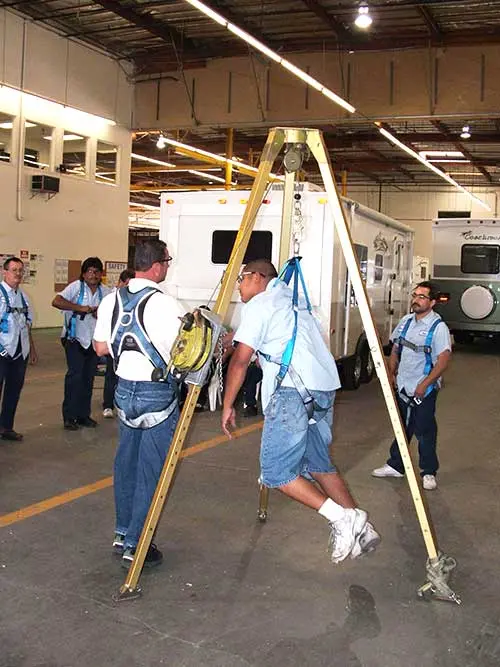
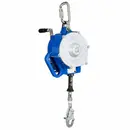
Only an SRL specifically designed with an approved rescue or retrieval function should be used for confined-space recovery. A retrieval SRL may allow an attendant to raise or lower a worker after a fall or emergency. It must be used with a compatible tripod or davit, anchorage, retrieval system, harness, and site-specific rescue plan. A standard fall-arrest SRL without a retrieval function should not be treated as a rescue device.
Inspect the SRL before each use or work shift for damaged webbing or cable, cuts, abrasion, corrosion, distorted connectors, unreadable labels, improper retraction, and failure of the locking mechanism. Complete formal periodic inspections at the frequency required by the manufacturer and the employer's fall protection program. Any SRL that arrests a fall must be removed from service immediately and evaluated before reuse.
CAI Safety can help evaluate the application type, anchor location, Class 1 or Class 2 capability, leading-edge exposure, required length, fall clearance, swing-fall potential, lifeline material, connector configuration, rescue requirements, and work environment. Use the filters on this page to narrow the available products, then contact CAI Safety for additional selection assistance. Final equipment selection and system compatibility must be confirmed by a qualified fall protection competent person.